

Registered vs Unregistered Easements: How They Affect Easement Valuation
Picture a valuer pulling the title for a house in Sydney’s west and finding a drainage easement along the back fence that the owner has never heard of. Down the road, another owner has shared a strip of driveway with the neighbour for 25 years, and there’s nothing on the title at all. Both situations involve an easement, but they create very different valuation problems.
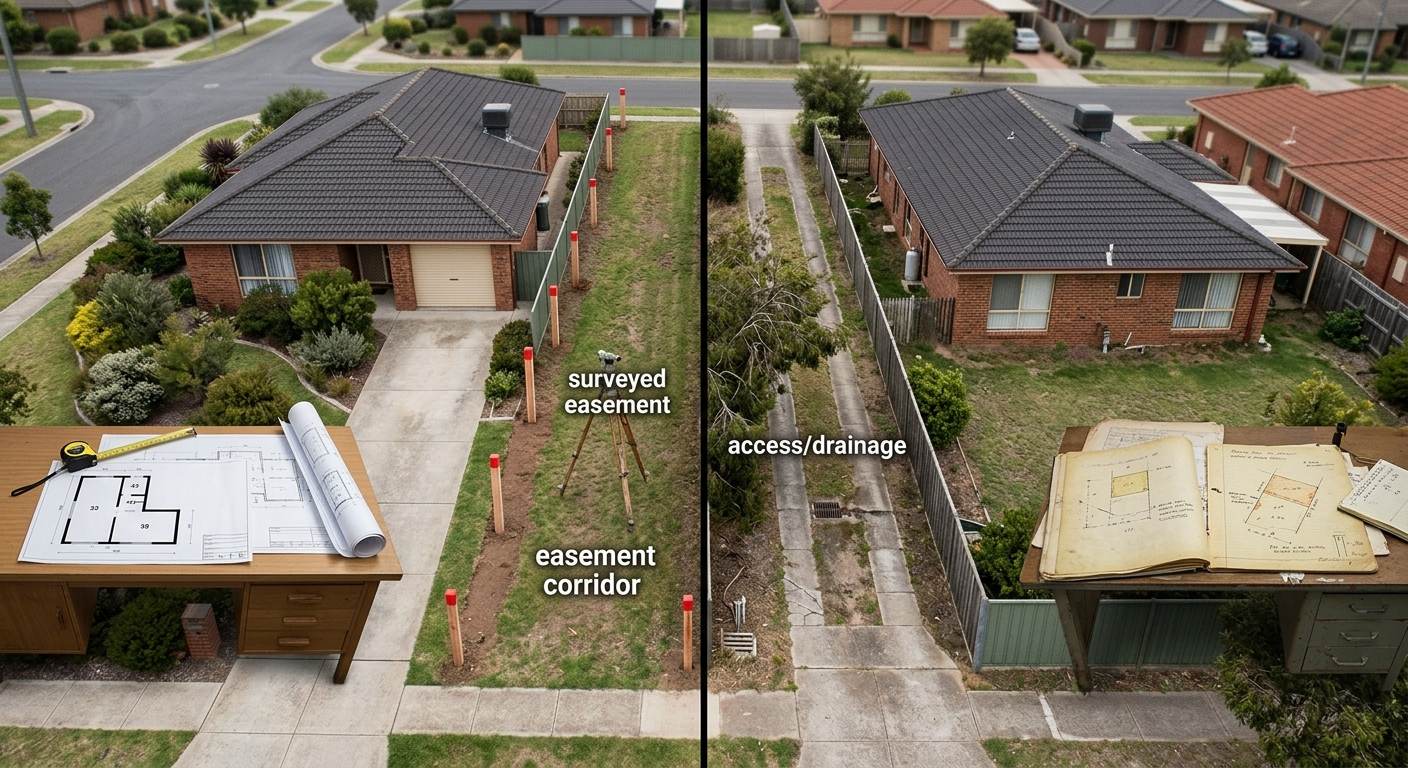
A registered easement is written on the title, so its terms can be read and priced. An unregistered one sits in the gap between what the paperwork says and what’s happening on the ground. That gap matters for easement valuation, because a valuer has to decide how much weight to give a right that may or may not bind the next owner.
This article covers how registered and unregistered easements differ, how each affects value, when a property valuation is needed, and what to check before you rely on a figure. It’s general information, not legal advice, and the rules vary between states and territories.
Summary
- An easement gives someone a right to use part of your land for a set purpose. It usually lowers the value of the burdened land and can raise the value of the land that benefits.
- Registered easements are recorded on the title and plan. Their location, width and purpose are clear, so they’re easier to value.
- Unregistered easements can still affect a property. Omitted easements, implied easements and, in some places, easements from long use may bind a registered owner. The rules differ by state.
- A valuer can’t ignore a possible unregistered easement. They’ll investigate, state their assumptions and may value the property more than one way.
- Before relying on any figure, get a title search, a survey, a site inspection and legal advice on whether the easement exists.
What Easement Valuation Involves
An easement is a right for a person or authority to use part of someone else’s land for a specific purpose. Common examples are a right of way (driveway access), drainage, sewer and water lines, and electricity infrastructure. The burdened land is called the servient land. The land that benefits is the dominant land.
In most cases the valuer is answering one question: how does this easement change what the land is worth? A common method is “before and after”. The valuer assesses the property without the easement, then with it, and the difference is the loss. In NSW, an easement counts as an “interest” in land under the Land Acquisition (Just Terms Compensation) Act 1991, and the courts often prefer the before and after approach when valuing easement acquisitions. Other states have their own compensation legislation.
What drives the number
Two properties with the same type of easement can end up with very different outcomes. The main factors are:
- Location. An easement along a side boundary is a very different thing to one through the middle of the lot.
- Width and length. A narrow pipe easement is a small burden. A wide carriageway can sterilise a building envelope.
- Intensity of use. A shared driveway for two houses is different to access for a 40-lot subdivision.
- Impact on development. Can you build over it, or does it block a future dual occupancy or subdivision?
- Maintenance and risk. Who pays for repairs, and what happens if something fails?
- Marketability. Some buyers simply won’t consider a property with certain easements, such as high-voltage transmission lines.
Registered Easements: Clear Terms, Easier to Value
A registered easement is recorded on the certificate of title and on the registered plan (a Deposited Plan in NSW). That gives everyone, including a buyer, a bank and a valuer, the same starting point.
Why the terms matter
The wording of the easement does a lot of the work. It sets out what the holder can do, how wide the easement is, who maintains it and whether the owner can build over or near it. In NSW, courts assessing easement compensation look at the registered terms, rather than outside material, apart from the physical characteristics of the properties when the easement was created.
A 1.5-metre drainage easement along a rear boundary might barely register in a valuation. A 4-metre right of carriageway running through a large lot in Camden or Wollongong is a different matter, because it can cut the land’s development potential.
One catch is that the plan and the ground don’t always match. A pipe may not sit where the plan says it does. A survey and a site inspection will pick that up.
Unregistered Easements: Why They Still Count
Under the Torrens system, the register is meant to be the final word on who owns what. But no Torrens statute is absolute, and every one contains a list of exceptions to indefeasibility. Easements are one of the main exceptions. Torrens legislation in every Australian state and territory includes an exception for “omitted” easements.
Common forms of unregistered easements
- Omitted or misdescribed easements. The easement was validly created but never made it onto the current title.
- Implied easements. These can arise from circumstances, for example when a lot is subdivided and one lot clearly relied on a path or driveway across the other.
- Prescriptive easements. These arise from long, uninterrupted use, often a shared driveway or access track.
- Statutory rights for infrastructure. In some cases, services run through land under legislation rather than a registered easement.
- Proposed easements that never got registered. In Hillpalm v Heaven’s Door (2004), the High Court dealt with a “proposed right of way” shown on a subdivision plan that was never registered under the Real Property Act, and whether the owner could be made to grant it.
- Informal arrangements. A handshake deal or permission to use a path is often a personal right and may not bind a new owner.
The rules differ by state
This is where people get caught out. In Victoria, an unregistered easement is one of the listed exceptions to indefeasibility under the Transfer of Land Act 1958 (Vic), and unlike most Australian jurisdictions, an easement can arise by prescription. By contrast, in some states, implied and prescriptive easements have been eliminated or limited over Torrens land, and uncertainty remains about when they’re enforceable.
The law is also still developing. The High Court has an appeal (Les Denny Pty Ltd v Valmorbida) about whether a prescriptive easement can arise when the servient land changes hands during the 20-year period, and how that fits with Torrens indefeasibility. The result could refine the Victorian position, so check the current law with a solicitor.
Registered vs Unregistered Easements at a Glance
| Registered easement | Unregistered easement | |
| Visible on title? | Yes | Usually not |
| Terms | Written down, with a plan | May be unclear or disputed |
| Binds a new owner? | Yes | Depends on the type and the state |
| Evidence needed | Title and plan | Title, site inspection, history of use, legal opinion |
| Valuation certainty | Higher | Lower, so assumptions are needed |
| Main risk | Burden on development or use | Surprise claims, disputes, uncertain legal status |
How Easement Valuation Changes When an Easement Isn’t Registered
A valuer can’t just ignore it
If there’s physical evidence of an easement, such as a worn track, a shared driveway, pipes or a neighbour’s fence built around a path, a valuer should take it seriously. Leaving it out can overstate the value of the burdened land. It can also understate the value of the land that depends on the right.
Assumptions and scenarios
A valuer isn’t a court. They can’t decide whether an unregistered easement legally exists. What they can do is spell out their assumptions and, where the stakes justify it, value the property under more than one scenario: with the easement, and without it. The report will usually recommend legal advice on the question the valuer can’t settle.
The benefit side matters too
Easements aren’t only a burden. For the land that benefits, a registered right of way might be the only legal access to a battleaxe lot. Take a hypothetical rear lot with access across the front lot. If that access is registered, the rear lot is worth what a lot with legal access is worth. If it’s only informal, a buyer or lender may discount the rear lot heavily, or refuse to lend at all, until the access is formalised.
When Easement Valuation Is Needed
- Compulsory acquisition. An authority acquires an easement for pipes, cables or roads and owes compensation.
- Court-ordered easements. In NSW, the Supreme Court may impose an easement under section 88K of the Conveyancing Act 1919 where the statutory requirements are satisfied, including reasonable necessity, public interest, adequate compensation and unsuccessful reasonable attempts to obtain the easement; compensation is generally provided unless special circumstances justify otherwise. In one 2023 Sydney CBD case, the court set compensation at $63,000. That figure is only one case, not a benchmark, as every property is different.
- Neighbour negotiations. Both sides need an independent figure to negotiate from.
- Sales, purchases and development. An easement can change what a buyer will pay or what a site can yield.
- Disputes and estates. Easement evidence can come up in litigation, deceased estates and family law property matters.
What to Check Before You Rely on a Valuation
- Get a current title search and the registered plan for the property and its neighbours.
- Commission a survey if the easement’s location matters. An identification or detail survey shows what’s actually on the ground.
- Inspect the site for tracks, pipes, access points and shared structures.
- Check for services using Before You Dig Australia, and ask the relevant utility about infrastructure.
- Collect any written agreements with neighbours, along with sale contracts and old plans.
- Ask a solicitor or conveyancer whether an unregistered right exists and whether it would bind a purchaser.
- Tell the valuer everything. The more they know about the easement, the more reliable the assessment will be.
Common Misconceptions
- “If it’s not on the title, it doesn’t exist.” Not always. Several kinds of unregistered easement can bind a registered owner.
- “A handshake deal protects me.” Informal permission is often personal and may not survive a sale.
- “An easement always slashes the value.” It depends on size, location and use. Some are barely noticeable.
- “Registered means no valuation problem.” Registered easements are clearer, but valuing the effect still takes judgement.
FAQs
Does an unregistered easement affect my property’s value?
It can. If it’s likely to bind a buyer, it affects marketability and may reduce value. A valuer will usually state their assumptions and may value the property both ways.
Can I register an easement I’ve been using informally?
Sometimes, usually by agreement with the owner, or by court order or recognition where the law allows it. A solicitor can advise on the right path in your state.
Will a bank valuation pick up an easement?
Registered easements on the title will normally be noticed. Unregistered ones are more likely to be missed unless they’re visible on inspection, so a specialist easement valuation may be worth considering.
Does a registered easement always reduce value?
No. A small drainage easement on a boundary may have little effect, while a wide access easement across a development site can have a large one.
How is compensation for an easement worked out?
In many cases it’s assessed using a before and after comparison of the property’s market value, within the legal framework that applies to the situation.
Conclusion
Whether an easement is registered or not, the easement valuation question is the same: how does it change what a buyer would pay? Registered easements give a valuer clear terms to work with. Unregistered ones need investigation, careful assumptions and often legal input. Check the title, inspect the land and sort out the legal status before relying on any figure.
Need Help With an Easement?
If you’re dealing with a registered or unregistered easement and need an independent opinion on its effect on value, Easement Valuations can help. We prepare valuations and compensation assessments for property owners, solicitors and developers. You can call us on +61 438 080 786 to talk through your situation.