

Can I Use Purchase Price Instead of a Stamp Duty Valuation NSW?
If you’ve just bought a property in New South Wales, there’s a good chance you’re assuming the price on your contract is simply what you’ll pay transfer duty on. Most of the time, you’d be right. But not always — and getting this wrong can mean an unexpected duty bill, a request from Revenue NSW for evidence you don’t have, or the need to arrange a professional property valuation before the transaction can proceed smoothly.
The short answer is: you can usually use the purchase price, but only if the sale was genuinely at arm’s length. If it wasn’t — say you bought from a family member, a company you’re connected to, or a trust — Revenue NSW will generally want a proper stamp duty valuation NSW report before it will accept the figure you paid.
This article walks through exactly when purchase price is enough, when a formal valuation is required, what “arm’s length” actually means in practice, and what happens if you get it wrong.
Summary
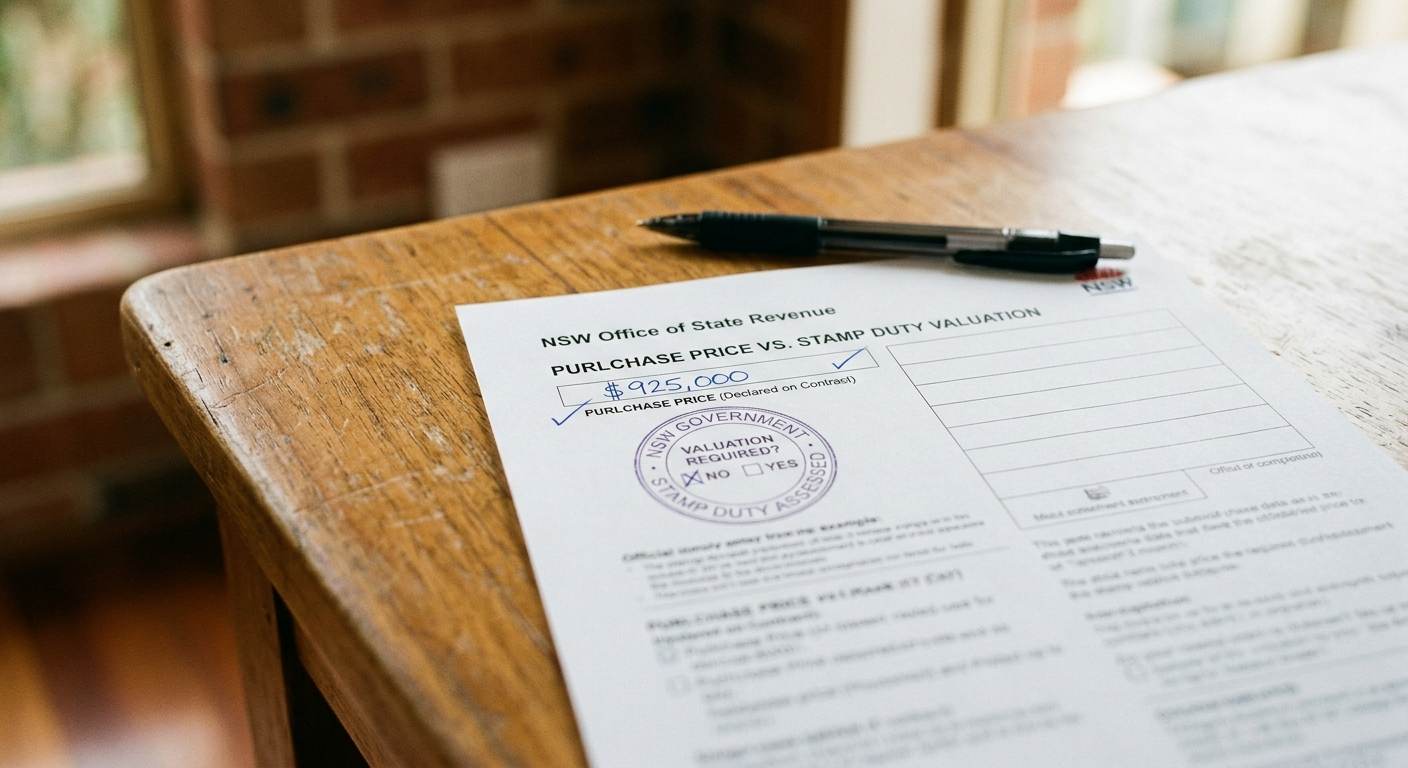
Transfer duty (what most people still call stamp duty) in NSW is calculated on the “dutiable value” of a property — and that’s not always the same as what you paid for it. Dutiable value is the higher of the purchase price or the property’s market value. For a normal, competitive, open-market sale between two unrelated parties, those two figures are the same thing, so your contract price does the job.
Problems arise when the sale isn’t at arm’s length — transfers between family members, related companies, trusts, or deals where there’s no independent selling agent involved. In these situations, Revenue NSW can’t simply take your word (or your contract price) for the property’s worth, so it requires supporting evidence in the form of a formal valuation from a suitably qualified valuer.
The key things to take from this article:
- Purchase price is fine for most standard, arm’s length purchases.
- A formal valuation is needed for related-party transfers, gifts, non-monetary deals, off-market sales without an agent, and a handful of other specific scenarios.
- Duty is charged on whichever figure is higher — so paying less than market value doesn’t reduce your duty if you’re related to the seller.
- Getting the right valuation evidence for NSW property transfers organised early can help avoid delays at settlement and problems if Revenue NSW later queries your figures.
What Counts as a Stamp Duty Valuation NSW and Why It Matters
A stamp duty valuation (technically called a transfer duty valuation in NSW, since “stamp duty” was rebadged “transfer duty” some years back) is an independent, professional assessment of a property’s market value, prepared specifically so Revenue NSW can confirm the correct amount of duty is being paid on a transaction.
Under the Duties Act 1997 (NSW), duty isn’t actually calculated on “the purchase price.” It’s calculated on the dutiable value, which Revenue NSW defines as the higher of:
- the price you agreed to pay for the property, or
- the property’s market value — the price it could reasonably be expected to fetch if sold on the open market, free of any encumbrances such as a mortgage.
For the vast majority of everyday purchases — buying a house through a real estate agent, bidding at auction, or negotiating with a stranger through a standard sale process — the purchase price and market value end up being the same number. That’s because a genuine, competitive, open-market process is generally accepted as good evidence of what a property is actually worth. In those cases, you don’t need to organise a separate valuation just to lodge your duty.
Where things change is when the sale doesn’t happen at arm’s length, or when there’s some other reason Revenue NSW can’t be confident the price reflects true market value.
What “Arm’s Length” Actually Means
You’ll see this term everywhere in duty and tax law, and it’s worth understanding properly. A transaction is “at arm’s length” when it’s between two unrelated parties, each acting in their own interest, with no special relationship or shared incentive influencing the price. Think of a stranger buying your investment property through a listed sale with an agent — neither side has a reason to inflate or deflate the price, so the outcome reflects genuine market value.
The opposite is a “non-arm’s length” transaction: a sale between people or entities with a connection that could affect the price. A father selling a block of land to his son below market value is the classic example — nobody would blame the son for wanting a good deal, but Revenue NSW can’t just accept that discounted figure as evidence of the land’s real worth.
When You Can Rely on Purchase Price Alone
You generally won’t need to arrange a separate stamp duty valuation NSW report if your purchase looks like this:
- You bought at a public auction. Competitive bidding between unrelated buyers is strong evidence of market value in itself.
- You bought through a real estate agent in a standard listed sale, where the property was genuinely exposed to the open market and buyers competed independently.
- The buyer and seller have no personal, family, business or financial connection to each other.
- You paid in cash or through normal financing, rather than through some non-monetary arrangement (like swapping assets).
Worked Example: Auction Purchase
Say you buy a house in Yamba at auction for $1,350,000 after spirited bidding against several other buyers. Because the auction was a genuine open-market process, Revenue NSW treats the sale price as the market value. Duty is simply calculated on $1,350,000 — no valuation report needed.
Interestingly, this also applies if you end up paying more than the guide price. If you make a pre-auction offer well above recent comparable sales to secure a property you love, Revenue NSW will still use the higher figure you actually paid as the dutiable value, since that’s the genuine consideration for the transaction — again, no formal valuation required.
When a Formal Valuation Is Required
Revenue NSW sets out circumstances where evidence of value will usually be required because the consideration may not reliably establish the property’s unencumbered value; depending on the circumstances, this does not always mean a comprehensive valuation report is required. These include when:
- There’s no consideration at all — for example, a property is gifted outright.
- Consideration is non-monetary — such as transferring property in exchange for shares, other assets, or services rather than cash.
- The parties are related or associated persons — family members, related companies, or connected trusts and beneficiaries.
- There’s no selling agent involved in the sale agreement (a genuinely private, off-market deal).
- The same solicitor or conveyancer acts for both the buyer and the seller.
- The transaction involves a fractional or partial interest in a property, rather than the whole thing.
- Revenue NSW simply isn’t satisfied that the price paid reflects the property’s true unencumbered value, and asks for evidence.
Worked Example: Family Transfer Below Market Value
Consider a parent who owns vacant residential land worth around $450,000 and sells it to their adult child for $300,000, to help them build a family home. Even though $300,000 genuinely changed hands, this is a related-party transaction, so Revenue NSW won’t accept the discounted price as the dutiable value. A formal valuation will typically be needed to establish the $450,000 market value, and duty is calculated on that higher figure — not on what was actually paid.
This surprises a lot of families. The common misconception is “we did pay something, so surely duty is based on that.” Unfortunately, once a sale isn’t at arm’s length, the actual cash paid becomes almost irrelevant to the duty calculation — what matters is independently verified market value.
Other Situations Where Valuations Commonly Come Up
- Transferring property into a self-managed super fund (SMSF) or a family trust.
- Deceased estate transfers where beneficiaries are taking property at other than equal shares, or a beneficiary is buying out other beneficiaries’ interests.
- Property settlements between separating couples that fall outside the usual duty exemptions.
- Business sales where real property forms part of a larger asset or share sale.
- Landholder duty transactions, where duty applies to acquiring an interest in an entity that holds significant NSW land, rather than the land itself.
Who Can Actually Provide a Valid Valuation
Not just anyone can sign off on a valuation for Revenue NSW purposes. Under Revenue Ruling DUT 044, the valuer needs to be “suitably qualified” — in practice, a registered property valuer with relevant professional credentials and no conflict of interest in the transaction (so the buyer’s own real estate agent giving an informal appraisal generally won’t cut it).
A compliant valuation report needs to:
- be prepared by an independent, appropriately qualified valuer
- reflect the property’s full market value in its current condition
- be dated at, or close to, the actual transaction date
- confirm that a physical inspection of the property took place
- set out the evidence and methodology used (typically comparable sales analysis).
Revenue Ruling DUT 012 sets out the detailed evidence requirements Revenue NSW expects, and it’s worth a look if you’re a solicitor, conveyancer or accountant handling these transactions regularly.
Common Misconceptions to Watch Out For
- “We agreed a fair price between ourselves, so that’s what duty should be based on.” Fair to both parties isn’t the same as arm’s length in Revenue NSW’s eyes — a personal relationship between buyer and seller is enough to trigger the valuation requirement, regardless of how reasonable the price seems.
- “I’m buying below market value, so I’ll pay less duty.” As the family transfer example shows, this is often the opposite of what actually happens — duty is charged on whichever figure is higher, so a discounted related-party sale can mean paying duty on an amount you never actually paid.
- “Any real estate agent’s appraisal will do.” A quick appraisal or a bank’s automated valuation model generally won’t meet Revenue NSW’s evidentiary standard. It typically needs to be a full valuation from a suitably qualified, independent valuer.
- “I can use the council rates notice or land value.” Council rates and Valuer-General land values are calculated for entirely different purposes and aren’t accepted as evidence of market value for transfer duty.
What Happens If You Get It Wrong
If duty is self-assessed on the purchase price when a formal valuation was actually required, and Revenue NSW later reviews the transaction, you could be facing a reassessment, additional duty on the corrected dutiable value, and potentially interest or penalties on top. This is one of the more common triggers for a Revenue NSW compliance review, particularly with family and related-party property transfers, so it’s worth getting the classification right at the outset rather than assuming your solicitor or conveyancer will catch it.
If you disagree with a valuation Revenue NSW relies on, or believe your own valuer’s figure is being challenged, there is a formal objection process — but it’s far easier to get a robust, well-evidenced valuation organised upfront than to argue about it after the fact.
Practical Steps If You’re Not Sure Which Category You Fall Into
- Check the relationship between buyer and seller. Any family, business, trust or shared-financial-interest connection is a strong signal a valuation will be needed.
- Check how the sale came about. A listed sale through an agent, or a competitive auction, is much stronger evidence of market value than a private arrangement.
- Ask your conveyancer or solicitor early. They’ll usually flag whether your transaction falls into one of Revenue NSW’s valuation-required categories before you get anywhere near settlement.
- If in doubt, get an independent valuation anyway. For related-party or off-market transactions, arranging a valuation from a suitably qualified valuer before lodging your duty return avoids delays and gives you a defensible position if Revenue NSW asks questions later.
FAQs
Do I need a valuation if I bought through a real estate agent at the advertised price?
Generally no. If the sale was genuinely open to the market and conducted at arm’s length, your purchase price is accepted as the dutiable value.
Does buying from a family member always require a valuation?
In almost all cases, yes. Family relationships are treated as non-arm’s length by Revenue NSW, regardless of how genuine or fair the agreed price was.
Can I use my bank’s valuation for my home loan as my stamp duty valuation?
Not usually. Bank valuations are prepared for lending risk purposes and typically don’t meet Revenue NSW’s requirements for an independent transfer duty valuation.
What if the property was transferred as a gift with no money changing hands?
A formal valuation is required, since there’s no purchase price at all to use as evidence of value.
How old can a valuation be when I lodge my duty return?
It needs to reflect the property’s value at, or close to, the actual transaction date — an outdated valuation from months earlier may not be accepted.
Who pays for the valuation?
There’s no fixed rule — it’s a cost buyers and sellers typically factor into the transaction themselves, similar to legal or conveyancing fees.
Conclusion
For most straightforward, arm’s length purchases in NSW, your contract price is all Revenue NSW needs. But family transfers, related-party deals, gifts and off-market sales generally require an independent stamp duty valuation to establish the true dutiable value — and duty is always charged on whichever figure is higher. If your transaction has any of these features, it pays to check early rather than risk a reassessment later.
Need an Independent Valuation?
If your transaction involves family members, a related company or trust, or any other non-arm’s length arrangement, it’s worth speaking with an independent valuer before you lodge your duty return. Easement Valuations can prepare a compliant stamp duty valuation report for Revenue NSW purposes, and can talk you through whether your specific transaction is likely to require one. Call Easement Valuations on +61 438 080 786 to discuss your situation.