


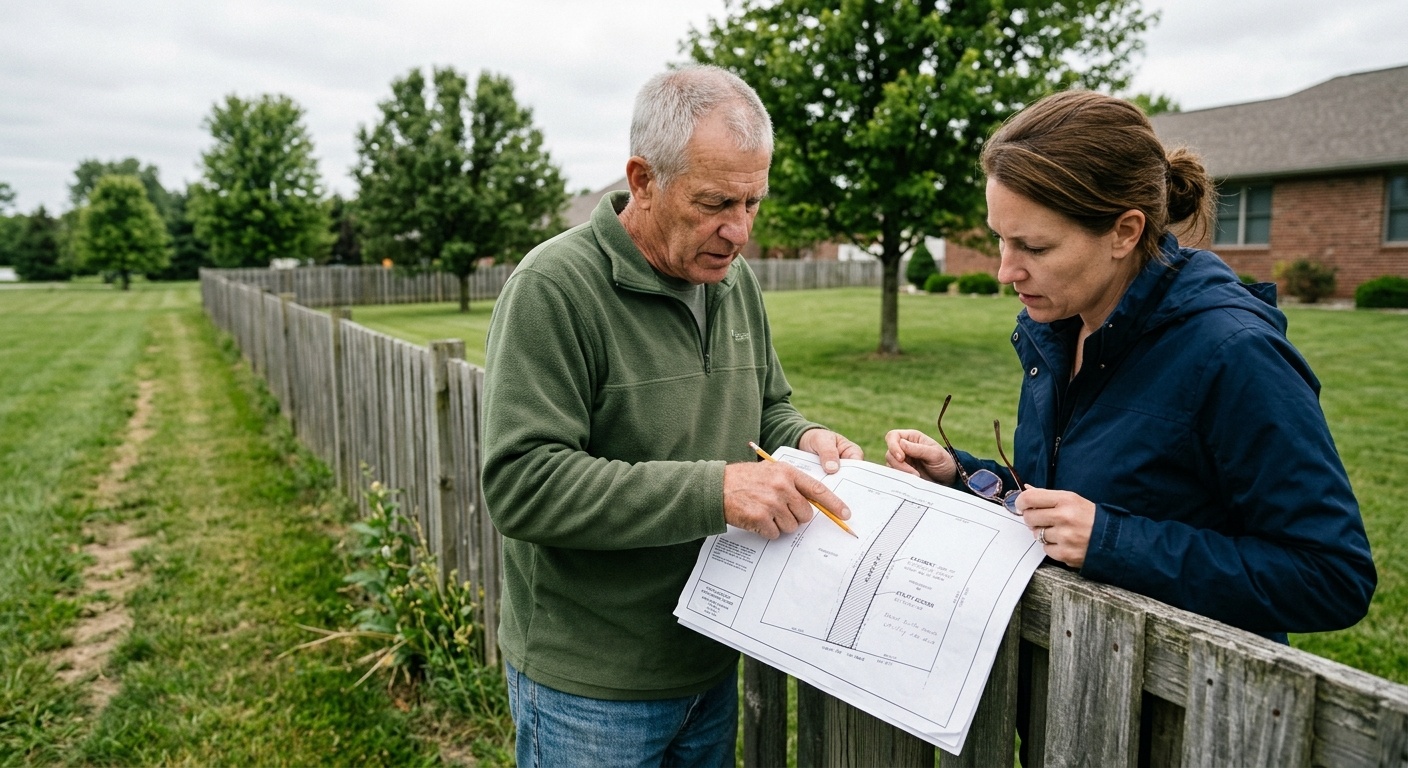
Does an Easement Reduce Your Property’s Value?
If you’ve just discovered an easement on your title — or you’re buying a property that has one — the first question is almost always the same: is this going to cost me money?
It’s a fair question. Easements sound serious. They’re registered on your title, they can restrict what you build, and in some cases they let someone else legally use part of your land. Naturally, that raises concerns about resale value, loan approval, and whether you’re paying full price for land you can’t fully use.
The honest answer is: it depends. Some easements have almost no effect on value. Others — particularly ones that restrict building on a large portion of the block, or that carry infrastructure like sewer mains or high-voltage transmission lines — can noticeably reduce what a buyer is willing to pay, making a professional assessment of the property’s value useful when the impact is unclear.
This guide walks through how easements actually work, when they genuinely affect market value, how a proper easement valuation is carried out, and what Australian property owners, buyers and investors should consider before assuming the worst (or ignoring the issue altogether).
Summary
An easement is a legal right for someone else — a neighbour, a council, or a utility provider — to use part of your land for a specific purpose, even though you remain the owner. Common examples in Australia include rights of way, drainage easements, and easements for sewer, water, gas or electricity infrastructure.
Whether an easement reduces value depends on a combination of factors: what portion of the block it covers, whether it prevents building or landscaping in that area, whether it’s visible or affects privacy, and whether it limits future subdivision or development potential. A narrow drainage easement along a side boundary might have no measurable impact at all. A wide right of way running through the middle of a block, or a transmission easement that sterilises a large chunk of usable land, can meaningfully reduce value.
Statutory land valuations (the kind used for council rates and land tax) are generally assessed on a hypothetical basis as if the land were unencumbered, though the physical effects of an easement — like a buried pipe or overhead line — are still taken into account. Market valuations, by contrast, look at the real-world impact on what a buyer would actually pay. This is why a proper easement valuation looks quite different from a standard valuation, and why relying on an online estimate or a general appraisal usually won’t capture the full picture.
If you’re buying, selling, settling a family law matter, negotiating compensation for a new easement, or dealing with a capital gains tax event, it’s worth understanding whether a professional assessment of the easement’s impact is warranted — rather than guessing.
What Is an Easement, and How Does an Easement Valuation Work?
An easement is a registered legal right that allows someone other than the landowner to use part of the land for a defined purpose. It’s recorded on the property’s title (in most states this is a Torrens title system), which means it stays attached to the land even when ownership changes hands.
The land carrying the burden is often called the “servient tenement.” If the easement benefits a neighbouring property — for example, a shared driveway — that neighbouring property is the “dominant tenement.” Not every easement has a dominant tenement, though. Many easements in Australia benefit a statutory authority, such as a water corporation or electricity network operator, rather than a neighbour.
An easement valuation is a specialist assessment that looks at what a property is worth with the easement in place, compared to what it would be worth without it (or before the easement was created, in the case of compensation matters). A before and after valuation method is one recognised approach in easement and partial-acquisition matters, although the appropriate methodology and compensation rules depend on the relevant legislation and circumstances.
It’s a different exercise to a standard market valuation, because it needs to isolate exactly how much of the value difference is attributable to the easement itself, rather than general market movement, condition of the dwelling, or other unrelated factors.
Common Types of Easements on Australian Titles
Most easements fall into a handful of familiar categories. Understanding which type you’re dealing with is the first step in working out whether it matters.
- Right of way — allows someone (often a neighbour, or the public in rural areas) to pass through part of your land to reach another property or road.
- Drainage easement — allows stormwater to flow across your land, usually via an underground pipe, often benefiting council infrastructure or neighbouring properties.
- Sewer or water easement — gives a water authority access to maintain pipes running through the property, and usually restricts building directly over them.
- Electricity or transmission easement — allows power lines (overhead or underground) or substations, and can restrict structures, plantings and sometimes even fencing within the easement corridor.
- Party wall or support easement — common in older terraces and semi-detached homes, allowing a shared wall to remain in place across the boundary.
- Easement for services — a broad category covering telecommunications cables, gas lines and similar utility infrastructure.
Some blocks carry more than one easement, particularly older or larger properties, or those adjoining bushland, creeks or major roads.
Does an Easement Always Reduce Property Value?
No — and this is probably the biggest misconception about easements. Plenty of properties across Australia have easements and sell at full market value without any discount at all.
A narrow drainage easement running along a rear boundary that nobody was planning to build on, for instance, often has no measurable effect. Buyers may not even notice it during a standard inspection, and it doesn’t change how the property is used day to day.
Where an easement valuation typically shows a genuine reduction in value is when the easement:
- Covers a significant proportion of a block’s buildable area.
- Prevents a planned extension, pool, garage or subdivision.
- Runs through the middle of the property rather than along a boundary.
- Carries visible infrastructure (poles, pits, substations) that affects street appeal.
- Reduces privacy, such as a right of way used regularly by third parties.
- Limits future development potential in an area zoned for higher density.
In these situations, the effect on value isn’t hypothetical — it’s the difference between what the land could be used for and what it can actually be used for, and buyers factor that in when they make an offer.
What Actually Determines the Size of the Impact
If an easement does affect value, the size of that effect depends on several factors a valuer will assess together, not any single one in isolation. Those factors can also help determine whether an easement valuation is necessary for the property.
Location on the block. An easement along a side or rear boundary is usually far less restrictive than one cutting through the centre of a block, because it leaves the most useful areas (near the house, in the backyard) unaffected.
Proportion of land affected. A drainage easement covering 5% of a large rural block behaves very differently to one covering 30% of a compact suburban lot.
Building restrictions. Some easements only prohibit permanent structures, meaning you can still landscape, park, or install a garden bed over them. Others prohibit almost any use, including deep-rooted trees or paving.
Visibility and amenity. Overhead transmission lines or an exposed pump station tend to affect buyer perception more than an underground pipe nobody can see.
Development potential. In growth corridors or areas earmarked for dual-occupancy or subdivision, an easement that blocks a second dwelling or driveway access can have an outsized effect on value, because it’s removing a future income or resale opportunity, not just current amenity.
Zoning and local context. The same easement can matter more in a high-density inner-Melbourne suburb than on a large rural block in regional Queensland, purely because of how tightly the remaining land is used.
Statutory Valuations vs Market Valuations: Why the Distinction Matters
This is where a lot of confusion comes from. In several Australian jurisdictions, the statutory land value used for council rates and land tax purposes is assessed on a hypothetical basis, as if the land were free of encumbrances such as easements — though physical impacts, like an easement containing an actual pipe or transmission line, are still reflected in the assessment.
A market valuation, on the other hand, reflects what a real buyer would actually pay for the property as it stands, easement and all. These two figures can differ, and it’s a common source of confusion for owners who compare their rates notice to what their property might actually fetch on the open market. If you believe an easement is affecting your land value assessment, most state valuer-general offices allow you to raise this specifically as part of an objection process.
Common Misconceptions About Easements and Value
“Any easement on the title means the property is worth less.” Not necessarily — plenty of easements have no practical effect on use or salability.
“Removing an easement will automatically increase value.” Easements can sometimes be removed or varied, but the process (often requiring agreement from the benefiting party, or a court/tribunal application) can be lengthy and isn’t guaranteed to succeed.
“The bank’s valuation will pick up any easement impact.” A standard mortgage valuation is a quick assessment focused on lending risk, not a detailed easement impact analysis — it may not properly isolate the value effect at all.
“Compensation for a new easement will be based on the whole property value.” Compensation is generally based on the loss in value the easement actually causes, assessed using the before-and-after approach, not a blanket percentage of the property’s total worth.
When a Professional Easement Valuation Is Worth Getting
An independent easement valuation tends to be genuinely useful — rather than just a formality — in situations such as:
- Buying or selling, where you want to understand whether an existing easement justifies a price adjustment.
- Negotiating compensation for a newly proposed easement, such as one required for a council drainage upgrade or a utility provider’s infrastructure.
- Compulsory acquisition matters, where an authority is acquiring part of your land or an easement over it under relevant state legislation.
- Family law property settlements, where an accurate, defensible value is needed for the asset pool.
- Capital gains tax events, particularly if an easement was granted or extinguished and the tax treatment depends on the value change.
- Disputes with a neighbour or authority over the extent of an easement’s impact, where an independent report can support a negotiation or tribunal application.
In most of these cases, a general appraisal or online estimate won’t hold up, because it doesn’t isolate the specific dollar impact of the easement itself — which is exactly what’s usually required.
FAQs
Does every easement need to be disclosed when selling a property? Yes. Easements registered on the title are part of the standard disclosure documents (such as the contract of sale and title search) provided to buyers, and they’ll typically show up during conveyancing regardless.
Can I build over an easement on my property? Generally no, without written consent from the party benefiting from the easement (such as the water authority or council), and even then, only certain structures may be permitted. Always check before starting any renovation or landscaping plans near an easement.
Can an easement be removed from a title? In some cases, yes — through agreement with the benefiting party, or by application to the relevant state tribunal or court if it’s no longer needed. It’s not automatic, and legal advice is usually required.
Do easements affect council rates or land tax? The underlying land value used for rates and land tax is often assessed on a hypothetical unencumbered basis in several states, though physical effects of an easement can still be factored in. If you think this hasn’t been applied correctly, most valuer-general offices allow you to raise it during a formal review.
How is compensation calculated when a new easement is created over my land? Valuers typically use a “before and after” approach — comparing the property’s value immediately before the easement existed to its value immediately after — with the difference forming the basis of compensation, alongside any additional disturbance costs.
Does a right of way affect value more than a drainage easement? Not automatically — it depends on how much the easement restricts use and how visible or intrusive it is, rather than the type of easement alone. A wide, frequently used right of way can affect value more than a narrow drainage line, but the reverse is also possible.
Conclusion
An easement doesn’t automatically reduce your property’s value — it depends on its size, location, purpose and how much it genuinely restricts use. Some have no real effect; others meaningfully limit development potential or buyer appeal. If you’re buying, selling, negotiating compensation, or dealing with a legal or tax matter involving an easement, an independent assessment gives you a defensible answer rather than a guess.
If you’d like an independent, evidence-based easement valuation for your property — whether it’s for a sale, purchase, compensation claim, family law matter or tax purpose — Easement Valuations can help. You can reach the team on +61 438 080 786 to discuss your situation and what’s involved.