

Transferring Property to Your Child in NSW: A Stamp Duty Valuation Guide
Most parents assume that if they’re not selling a property — just handing it over to a son or daughter — there’s nothing much to pay. No sale price, no stamp duty, right?
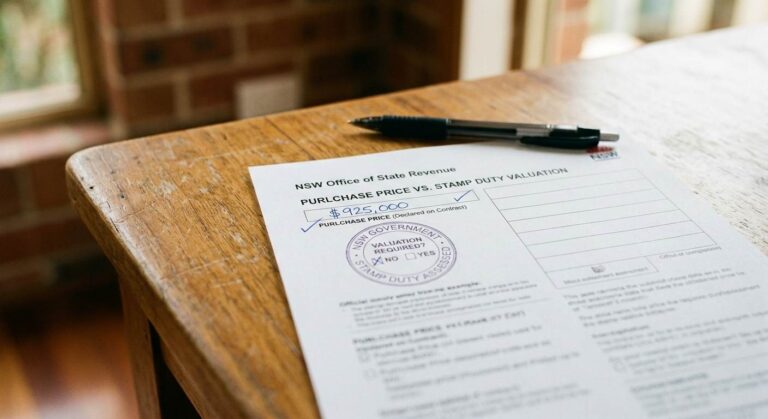
That’s one of the most common misunderstandings we come across. In NSW, transfer duty (still widely called stamp duty) is charged on the market value of a property, not on what the buyer actually pays for it. That means a parent can transfer a house to their child for nothing at all, and Revenue NSW will still assess duty as though it sold at full price. To work out what that duty actually is, Revenue NSW generally needs an independent stamp duty valuation NSW report before the transfer can be assessed.
This guide walks through why family transfers are treated this way, how the valuation and duty calculation actually works, the purpose of a property valuation in these situations, what it’s likely to cost, and the capital gains tax question that catches almost as many families out as the duty does.
Summary: What You Need to Know
Transferring a property to your child in NSW is treated, for duty purposes, much like an arm’s length sale to a stranger. There’s no blanket exemption for parent-to-child transfers — that surprises a lot of people, because exemptions do exist for spouses and de facto partners transferring the family home, and for transfers ordered under the Family Law Act.
The key points:
- Transfer duty is calculated on the higher of the price actually paid and the property’s unencumbered market value. If nothing is paid, duty is assessed on market value alone.
- Revenue NSW will almost always require evidence of value for a related-party transfer, and in most cases that means a valuation from a suitably qualified valuer.
- The duty is payable by whoever is receiving the property — your child, in this case — even though they haven’t paid for it.
- Gifting doesn’t get around capital gains tax either. The parent giving the property may trigger a CGT event based on market value, unless the property was their main residence.
- Getting an independent valuation early avoids delays, and gives you a defensible figure if Revenue NSW queries the transaction later.
If you take one thing away from this article, let it be this: get proper advice and a proper valuation before you sign anything, not after.
Why Transferring Property to Your Child Isn’t Duty-Free in NSW
Under the Duties Act 1997 (NSW), transfer duty applies whenever dutiable property changes hands — and that includes gifts. The fact that no money changes hands doesn’t remove the liability; it simply means Revenue NSW calculates duty on the property’s market value rather than a contract price.
There’s a short list of transfers that genuinely are duty-exempt or concessional in NSW:
- Transfers of the matrimonial home between spouses or eligible de facto partners.
- Transfers made under a Family Law Act order or binding financial agreement following separation.
- Certain transfers of land used for primary production between family members (the “family farm” exemption, which has its own strict eligibility rules).
- Deceased estate transfers to a beneficiary named in the will, which attract a concessional rate rather than full duty.
Notice what’s missing: an ordinary transfer from parent to adult child isn’t on that list. Whether you’re gifting the property outright, selling it to your child for a nominal amount, or selling it at a genuine discount, Revenue NSW treats the transaction the same way — duty is worked out on market value.
How Revenue NSW Calculates Dutiable Value on a Family Transfer
The starting point is the concept of dutiable value. Under the Duties Act, this is the greater of the price paid for the property and its unencumbered market value at the time of the transfer.
For a normal sale between unrelated parties, these two figures are usually the same — the market sets the price. Family transfers are different, because the price (if there is one at all) doesn’t necessarily reflect what the property is actually worth, which is why it is important to understand whether purchase price can be used for stamp duty purposes in different NSW property transactions. That’s exactly why Revenue NSW pays closer attention to these transactions.
Revenue NSW’s ruling on evidence of value (Revenue Ruling DUT 012) sets out when it will ask for proof of a property’s value rather than just accepting the figure on the transfer documents. Evidence of value is typically required where:
- There’s no consideration for the transaction (a straight gift).
- The consideration is non-monetary (for example, the child takes on the outstanding mortgage instead of paying cash).
- The parties are related or associated, which obviously covers parent and child.
- The same solicitor or conveyancer is acting for both sides.
- There’s no independent selling agent involved.
- Revenue NSW isn’t satisfied that the price paid reflects the property’s real value.
A family transfer will usually tick at least two or three of those boxes at once, which is why an independent valuation is close to unavoidable in this situation.
Who Can Actually Provide the Valuation?
Revenue NSW requires evidence of value from a person the Chief Commissioner considers “suitably qualified” — in practice, this generally means a Certified Practising Valuer through the Australian Property Institute, or an equivalent qualified member of a recognised valuers’ body. A rough estimate from a real estate agent, a bank valuation done for lending purposes, or a figure based on the council rates notice generally won’t be accepted as formal evidence of value for duty purposes — Revenue NSW is looking for an independent report, prepared specifically for this purpose, that sets out comparable sales evidence and reflects a physical inspection of the property.
Current NSW Transfer Duty Rates (2026–27)
Once you know the dutiable value of the property, the applicable NSW transfer duty rates can be applied. These are the standard NSW transfer duty rates and thresholds for the 2026–27 financial year:
| Dutiable value | Transfer duty payable |
| $0 – $18,000 | $1.25 for every $100 (minimum $20) |
| $18,001 – $38,000 | $225 plus $1.50 for every $100 over $18,000 |
| $38,001 – $103,000 | $525 plus $1.75 for every $100 over $38,000 |
| $103,001 – $387,000 | $1,662 plus $3.50 for every $100 over $103,000 |
| $387,001 – $1,290,000 | $11,602 plus $4.50 for every $100 over $387,000 |
| Over $1,290,000 | $52,237 plus $5.50 for every $100 over $1,290,000 |
Residential property valued above $3,870,000 attracts premium transfer duty, calculated as $194,137 plus $7.00 for every $100 over that threshold.
So if a parent’s investment unit in Sydney’s inner west is valued at $900,000 and is gifted outright to an adult child, duty is assessed on that $900,000 figure — working out to $11,602 plus 4.5% of the amount over $387,000, or roughly $34,700. Not a small number, and one that’s often overlooked in early family planning conversations because nobody’s actually paying $900,000 for anything.
Step-by-Step: Transferring Property to Your Child in NSW
- Get an independent stamp duty valuation NSW report. This establishes the market value Revenue NSW will use to calculate duty, and it’s the document that protects both sides if the figure is ever questioned later.
- Speak to a conveyancer or solicitor early. They’ll prepare the transfer documents, and if the transfer is a genuine gift, a deed of gift or similar documentation is usually needed alongside the standard transfer form.
- Check the mortgage position. If there’s an existing loan on the property, you’ll need the lender’s consent to transfer, or your child will need to refinance in their own name.
- Get tax advice before you sign anything, not after. A quick conversation with an accountant about CGT and, if relevant, Centrelink gifting rules, can change how — or when — you structure the transfer.
- Lodge the transfer with the assessed duty through Revenue NSW, generally via the electronic conveyancing system, and register the transfer with NSW Land Registry Services.
- Keep the valuation report. It becomes part of the record for both the duty assessment now and any future CGT calculation for your child down the track.
Capital Gains Tax: The Cost Parents Often Miss
Stamp duty is usually the first thing families think about, but it’s rarely the only tax consequence. If the property isn’t your main residence — think an investment property, a holiday house, or land that’s been rented out — gifting it to your child can trigger a capital gains tax event for you as the person giving it away.
The ATO applies what’s called the market value substitution rule. In plain English: if you transfer property to family for less than it’s worth (including for nothing at all), the ATO treats you as though you received full market value for CGT purposes, not the amount actually paid. So a gain can arise even though not a dollar changed hands.
There is an important exception. If the property has genuinely been your main residence for the entire time you’ve owned it, the main residence exemption may mean the gain is disregarded altogether. Where things get complicated is if you’ve ever rented the property out, moved out and left it vacant, or used part of it to run a business — any of those can reduce or remove the exemption, and working out exactly how much is genuinely a job for your accountant, not a rule of thumb.
This is also where the same independent valuation used for stamp duty purposes earns its keep twice over — it establishes both the dutiable value for Revenue NSW and the capital proceeds figure for the CGT calculation.
Common Ways Families Try to Reduce Duty — and Why They Don’t Work
A few ideas come up again and again in conversations with families. Worth addressing them directly:
“We’ll just sell it for $1.”
Doesn’t work. Duty is based on the higher of price paid and market value, so a $1 sale price is simply ignored in favour of the property’s actual value.
“There’s no contract, so there’s nothing to value.”
Also doesn’t work. A gift is still a dutiable transaction under the Duties Act, and the absence of a sale contract is actually one of the triggers that makes Revenue NSW more likely to ask for formal evidence of value, not less.
“We’ll use the council rates valuation instead of getting our own valuation.”
The land value shown on a council rates notice reflects unimproved land value for rating purposes — it’s not a market valuation of the whole property (house, improvements and all) and generally isn’t accepted as evidence of value for a family transfer.
“Dad’s an accountant, he can just write a letter with a value.”
Revenue NSW is specific about who counts as suitably qualified to provide evidence of value, and it isn’t a general accounting or legal qualification — it needs to come from a qualified property valuer.
A Consideration Families Often Overlook: Centrelink and the Age Pension
If the parent gifting the property is receiving, or might in future receive, the Age Pension or another means-tested Centrelink payment, giving away a valuable asset can affect the pension assets test and income test for up to five years after the gift, depending on the amounts involved and any gifting-free thresholds that apply at the time. This is a separate issue from stamp duty and CGT, but it’s exactly the kind of thing that’s easy to miss when the family’s focus is on the property transaction itself. It’s worth raising with a financial adviser or Services Australia before the transfer goes ahead, particularly for older parents.
Frequently Asked Questions
Do I really have to pay stamp duty if I’m gifting property to my child for free?
Yes, generally. NSW doesn’t have a parent-to-child exemption. Duty is assessed on the property’s market value even though no money is changing hands, so a formal valuation is usually the first step.
Who pays the stamp duty — the parent or the child?
The person receiving the property, so in a parent-to-child transfer, it’s your child who’s liable for the duty, even though they haven’t paid a purchase price.
Can I avoid stamp duty by transferring the property into a family trust instead?
Generally no — transfers to a family trust or company are also dutiable on market value in most circumstances, and the rules around trusts can be more complex, so it’s worth getting specific advice before assuming this is a workaround.
Is a real estate agent’s appraisal good enough for Revenue NSW?
Usually not. Revenue NSW expects evidence of value from a suitably qualified valuer — in practice, a Certified Practising Valuer or equivalent — rather than an agent’s informal price opinion.
What happens if we don’t get a valuation and just guess the value?
Revenue NSW can request evidence of value after the transfer is lodged. If you can’t provide it, or the figure used turns out to be too low, the transaction can be reassessed at Revenue NSW’s own valuation, along with potential interest and penalties — with no right to negotiate that figure the way you could with your own independent report.
Does transferring a share of the property (say, 50%) change any of this?
The same principles apply to fractional interests — duty is still calculated on the market value of the share being transferred, and Revenue NSW treats partial transfers between family members as another situation where evidence of value is generally required.
Conclusion
Gifting or transferring property to your child in NSW rarely comes duty-free. Because Revenue NSW assesses duty on market value, not the price paid, an independent stamp duty valuation NSW report is usually essential — and it also feeds into any capital gains tax calculation. Get the valuation and the tax advice sorted before you sign anything, so there are no surprises for either generation.
Need an Independent Valuation for a Family Property Transfer?
If you’re planning to transfer property to your child and need an independent market valuation that Revenue NSW will accept as evidence of value, Easement Valuations can help. Get in touch on +61 438 080 786 to discuss what’s involved for your particular property and timeline.